
Anxiety Symptoms
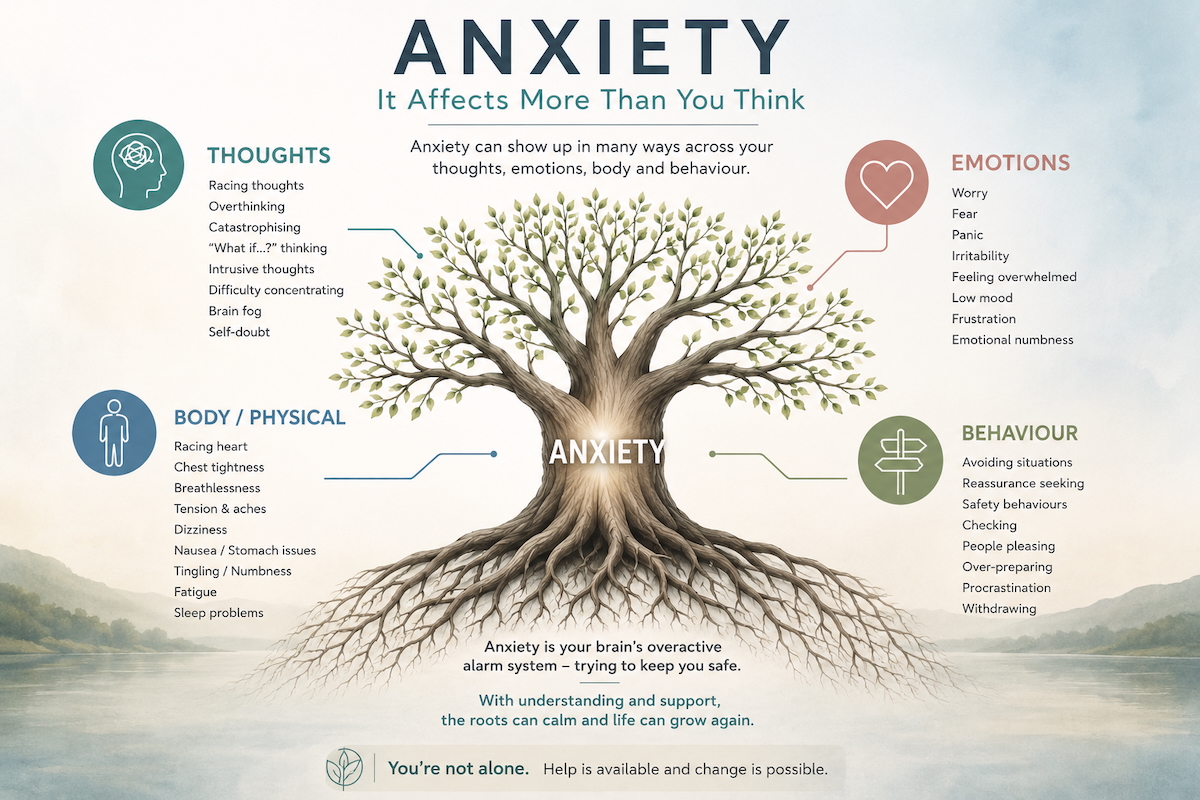
Why Anxiety Can Feel So Frightening – and Why You’re Not Alone
Have you ever found yourself wondering:
“Why do I feel dizzy?”
“Why is my heart racing?”
“Why do I suddenly feel sick before leaving the house?”
“Am I going crazy?”
If so, you’re far from alone.
Anxiety can produce an extraordinary range of physical, emotional and mental symptoms. I could literally write a thick book on the symptoms of anxiety alone! In fact, one of the most distressing aspects of anxiety is that it often feels as though something serious must be wrong. Many people spend weeks, months or even years searching for an explanation before realising that anxiety itself can create remarkably real and convincing sensations.
The important thing to remember is this:
The symptoms are real.
They’re not imagined, exaggerated or “all in your head.” They’re genuine experiences created by a nervous system that’s become overprotective. Once you understand why this happens, those symptoms often become much less frightening.
Why Does Anxiety Cause So Many Symptoms?
Your brain has one primary job: to the best of its ability, it tries to keep you alive.
Long before we had cars, offices and smartphones, our ancestors faced genuine dangers. The amygdala in our brains is the threat system developed over hundreds of thousands of years. When our brains were more primitive, people would go out hunting. If they heard a rustle in the bushes, their brain had to make a split-second decision.
“Could that be a predator?”
It was far safer for the brain to assume danger and be wrong than to ignore a threat and be right.
That ancient alarm system still exists today.
The difference is that modern dangers are more likely to be deadlines, difficult conversations, financial worries, health concerns or uncertainty about the future. We have even retained our startle response, so even though a person may not be afraid of spiders, if one suddenly appeared on their clothing, there would still be a spike in adrenaline before it settles. Or if someone plays a trick on you and jumps out of the bushes as you walk past, the startle response is quite normal, even though it’s only a friend.
Unfortunately, your nervous system doesn’t always distinguish between a charging bear and an email from your boss.
It prepares your body for action.
Your heart beats faster.
Your breathing changes.
Blood is redirected towards large muscles.
Digestion slows.
Your senses become more alert.
Your thoughts speed up as your brain searches for possible threats.
None of these changes is harmful. They’re designed to help you survive.
The problem comes when the alarm becomes too sensitive.
Instead of switching off once the danger has passed, it continues scanning for more evidence that something might be wrong.
And that’s when anxiety can begin to feel as though it’s controlling your life.
Anxiety Can Affect Almost Every Part of the Body
One of the biggest myths about anxiety is that it only causes worry.
In reality, anxiety can influence almost every system in the body.
That’s why two people with anxiety may have completely different symptoms.
One person may struggle with dizziness.
Another experiences nausea.
Someone else feels detached from reality.
Another notices constant muscle tension or headaches.
All of these experiences can stem from the same underlying process: an overactive threat detection system.
Common Physical Symptoms
Anxiety can contribute to sensations such as:
- Heart palpitations
- Chest tightness
- Breathlessness
- Hyperventilation
- Dizziness
- Feeling faint
- Nausea
- IBS symptoms
- Stomach cramps
- Butterflies
- Muscle tension
- Trembling
- Shaking
- Tingling hands and feet
- Hot flushes
- Cold shivers
- Sweating
- Headaches
- Jaw clenching
- Blurred vision
- Dry mouth
- Frequent yawning
- Lump in the throat
- Tight chest
- Fatigue
- Internal vibrations
- Muscle twitches
Each of these symptoms deserves its own explanation, which is why you’ll find detailed articles throughout this section of the website.
Common Mental Symptoms
Anxiety isn’t only experienced in the body.
It also changes the way we think.
You might notice:
- Racing thoughts
- Catastrophising
- Constant “what if?” thinking
- Intrusive thoughts
- Difficulty concentrating
- Brain fog
- Overanalysing
- Self-doubt
- Fear of losing control
- Fear of going mad
- Feeling detached from yourself
- Feeling as though the world isn’t quite real
- Constant checking
- Difficulty making decisions
These aren’t signs that you’re “broken.”
They’re signs that your brain is working overtime trying to keep you safe.
Behavioural Changes
As anxiety grows, it’s natural to begin avoiding situations that feel uncomfortable.
Perhaps you’ve stopped driving.
Avoid restaurants.
Cancel social events.
Stay close to home.
Google symptoms repeatedly.
Seek reassurance from friends or family.
These behaviours often bring temporary relief.
Unfortunately, they also teach the brain that those situations really were dangerous.
The cycle continues.
Why Symptoms Often Become Worse
One of the cruellest aspects of anxiety is that the fear of the symptoms often becomes more distressing than the symptoms themselves.
Imagine feeling a little light-headed.
Your brain immediately asks:
“What if I faint?”
Your body releases more adrenaline.
The dizziness increases.
Your brain says:
“See—I knew something was wrong.”
This creates a loop where fear fuels physical sensations, which in turn fuel more fear.
Breaking that cycle is one of the key aims of therapy.
You’re Not Weak
Many of the people I work with are teachers, nurses, police officers, business owners, parents and healthcare professionals.
They’ve coped with enormous challenges throughout their lives.
Anxiety isn’t a sign of weakness.
Very often, it’s a sign that someone has been strong for a very long time.
Sometimes the nervous system needs an opportunity to feel safe again.
When Should You See Your GP?
Although anxiety can cause a wide variety of symptoms, it’s always sensible to seek medical advice if symptoms are new, persistent, severe or unexplained.
Your GP can rule out physical causes and help ensure you’re receiving the most appropriate care.
Once serious medical conditions have been excluded, many people find it much easier to begin changing the way they respond to anxiety.
How Therapy Can Help
Therapy isn’t about forcing yourself to “think positively.”
Instead, it’s about helping your nervous system rediscover a sense of safety.
In my Warrington clinic, I integrate approaches such as hypnotherapy, EMDR, CBT, Acceptance and Commitment Therapy (ACT), Brainspotting and mindfulness techniques to help clients understand why anxiety happens and, more importantly, learn practical ways to respond differently.
As your confidence grows, the alarm system gradually learns that it no longer needs to react so intensely.
The symptoms often become less frequent, less frightening and far less disruptive.
Explore Anxiety Symptoms
Each symptom below has its own detailed guide explaining why it happens and practical ways to manage it.
You Are Not Alone
If you’ve recognised yourself in many of these symptoms, I hope one thing stands out above everything else:
You’re not going mad.
Your body isn’t trying to work against you.
It’s trying—sometimes a little too enthusiastically—to protect you.
With understanding, patience and the right support, that alarm system can learn to settle again.
And when it does, life often begins to feel much bigger than anxiety.