
EMDR therapy in Warrington and Cheshire.
EMDR Therapy in Warrington and Cheshire
As part of my ongoing commitment to high-quality annual training, I’ve become a fully certified EMDR practitioner. At my practice in Warrington, Cheshire (very close to Gulliver’s World), I use EMDR to treat a wide range of conditions, including PTSD, trauma, anxiety, and addictions. There is a protocol for every type of problem.
I’ve written some information for you to review, but if you have any questions, please don’t hesitate to contact me.
What Is EMDR, and How Does It Work?
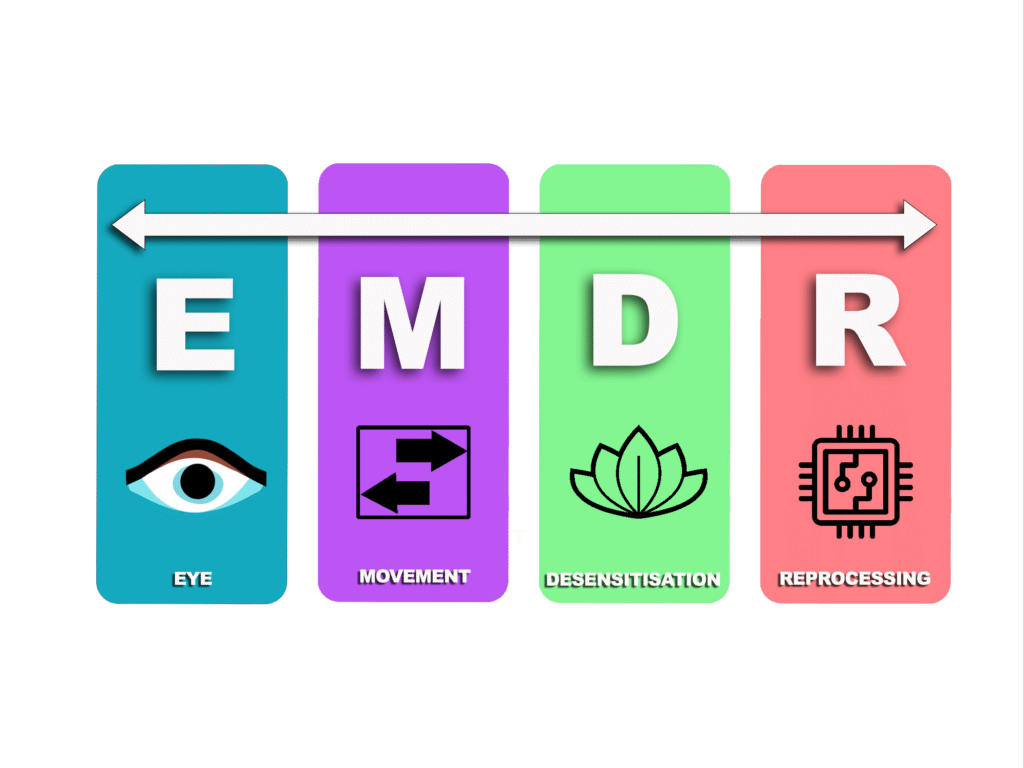
EMDR stands for Eye Movement Desensitisation and Reprocessing. It was discovered by therapist Francine Shapiro in 1987, when she noticed her anxiety decrease as she moved her eyes side to side while walking through a park.
This process—now called bilateral stimulation—is not limited to eye movements. It can also involve tapping on the upper arms, backs of the hands, or tops of the legs.
Bilateral stimulation helps patients process distressing memories and emotions by gently reworking how the brain stores and reacts to them. This can calm anxieties, release emotional blocks, and challenge old, unhelpful beliefs.
A major benefit of EMDR is that clients don’t need to talk in detail about their trauma. The focus is on shifting emotions and altering thoughts and behaviours.
How the Brain Stores Memories
How Triggers Work
Think about how a scent can instantly transport you back in time. For me, the smell of fresh apples brings back memories of elementary school—where we were given apples and lukewarm milk every morning. I can still recall the smell of that milk, even though it’s not in front of me.
This is the olfactory system at work. Smell is a powerful memory trigger.
But not all triggered memories are pleasant. For example, someone who was in an abusive relationship might feel anxiety or panic when smelling the cologne their ex-partner wore.
Sensory Triggers Beyond Smell
The brain can link trauma to other senses, such as sights, sounds, and even tastes. A specific colour or object might stir feelings of fear or sadness.
The hippocampus stores both positive and negative memories, but it processes them differently. Traumatic events can remain unprocessed, sitting in the brain like fragments—until a recent trigger brings them back.
This is where EMDR becomes particularly useful.
Reprocessing Traumatic Memories
EMDR helps access specific memories and the emotional reactions tied to them. The goal isn’t to forget the memory—but to lessen the emotional weight it carries.
The eye movement or tapping process assists in desensitising those emotional links, so recalling the memory no longer feels overwhelming.
What Happens During an EMDR Session?
The Eight Phases of EMDR Therapy
Although there are eight stages, we usually don’t cover all of them in a single session. The process begins with gathering a history and building inner resources.
The eight phases are:
-
History Taking and Treatment Plan
Reviewing past experiences and current symptoms to form a treatment plan.
-
Preparation
Building coping strategies and positive visualisations for comfort.
-
Assessment
Identifying the distressing event and the negative beliefs tied to it.
-
Desensitisation
Using eye movement or tapping to reduce the emotional impact.
-
Installation
Replacing negative beliefs with positive ones using slow stimulation.
-
Body Scan
Checking for remaining tension or discomfort in the body.
-
Closure
Ensuring the client feels stable and safe before ending the session.
-
Re-evaluation
Reviewing progress and identifying any areas needing more work.
Safe Places and Positive Resources
We begin by developing a “safe place”—a mental image of somewhere peaceful, like a beach or a grandparent’s garden. While visualising it, the client slowly taps their upper arms or thighs, which helps instil calm.
We also use other resource-building techniques to create emotional safety before addressing trauma.
Addressing the Traumatic Memory
When working with a difficult memory, I guide the client through the experience. We identify the most distressing image and ask how it affects their body and emotions today.
For example, someone might feel a tight, anxious sensation in their stomach. We measure this using SUDs—Subjective Units of Distress—on a scale of 0 to 10.
We also explore the client’s negative self-beliefs, such as feeling helpless. Then we develop a more empowering belief and rate how true that new belief feels.
EMDR helps shift the emotional balance toward this new belief.
The Reprocessing Phase
In Phase Four, the client focuses on the memory, emotions, and physical sensations. At the same time, they track my fingers moving left to right.
Some therapists use light bars, tactile buzzers, or headphones for auditory stimulation. For autistic clients, scanning between two dots on the wall can offer more control and comfort.
The goal is to reduce distress to zero and strengthen the new belief to a 7 out of 7.
Once the new belief is in place, we use slower movements to “install” it. If needed, we may revisit this process in follow-up sessions.
Body Scan and Closure
We finish with a body scan to check for lingering discomfort. If needed, we return to the safe place and do grounding exercises to ensure stability.
What Conditions Can EMDR Help With?
Although best known for trauma and PTSD, EMDR is much more versatile. At my Warrington practice, I’ve successfully used EMDR to help clients with:
-
Anxiety (including GAD, panic, and phobias)
-
PTSD and trauma
-
Depression
-
Dissociation
-
Eating disorders
-
Addictions (alcohol, drugs, gambling)
-
Low self-esteem
-
Confidence issues
-
OCD
-
Chronic pain
How Effective Is EMDR Therapy?
EMDR is well-supported by research. Over 40 clinical studies have shown its effectiveness, especially for trauma. In 2013, the World Health Organization (WHO) endorsed EMDR for trauma-related issues.
Many clients see improvements faster than with traditional talk therapy. It’s also less stressful since you don’t need to relive every detail of the trauma.
Are There Any Risks?
As with any therapy, EMDR has its critics. Some are cautious because its discovery was accidental and the exact mechanism is still debated.
However, risks are low. It’s normal to experience emotional responses or vivid dreams during treatment. These are signs that healing is underway.
Ready to Explore EMDR?
If you’re based in Warrington, Cheshire, and are curious about how EMDR can help, feel free to get in touch. I’d be happy to answer any questions or talk through whether it’s right for you.